
SHORTLIST · CURATED · DATED
Best E-commerce Email Tools 2026: Klaviyo, Omnisend + 8 More
Best email marketing platforms for ecommerce in 2026. Shopify, WooCommerce, and DTC-focused tools ranked by automation depth and ROI.
Best Email Marketing for Ecommerce 2026: Top 10
Shopify, WooCommerce, and DTC tools ranked by automation depth and real ROI.
Quick Pick: What Platform Are You On?
| Situation | Best Pick | Price |
|---|---|---|
| Shopify store (most popular choice) | Omnisend or Klaviyo | Free / $16-$20+/mo |
| WooCommerce store | Omnisend or ActiveCampaign | $16-$29/mo |
| High-volume SMS plus email | Omnisend | $16/mo+ |
| Budget under $20/mo | GetResponse or Moosend | $9-$15/mo |
| Building a newsletter alongside your store | beehiiv | Free / $43/mo |
| B2B wholesale outreach | Lemlist | $39/mo |

Omnisend
Omnisend connects natively to Shopify, WooCommerce, and BigCommerce and ships with pre-built automation workflows: abandoned cart, welcome series, browse abandonment, post-purchase, and win-back. The free plan covers 500 emails per month to unlimited contacts and includes the automation builder. SMS is included on paid plans at no additional platform fee, just per-message carrier costs. At $16/month the Standard plan unlocks unlimited emails, full automation, and the SMS channel. For a Shopify or WooCommerce store that wants to start email and SMS without configuring integrations from scratch, Omnisend is the fastest path to working flows. The product picker lets you insert live product blocks into emails directly from your store catalog. The segmentation engine uses purchase behavior, browsing data, and campaign engagement without requiring any manual tagging.
Where it falls short: Omnisend's automation logic is less flexible than ActiveCampaign's for complex branching scenarios. At higher list sizes and SMS volumes, the cost climbs quickly. The email editor is functional but not the most polished. For stores doing over $1M/year, Klaviyo's predictive analytics and deeper data layer become worth the higher price.

GetResponse
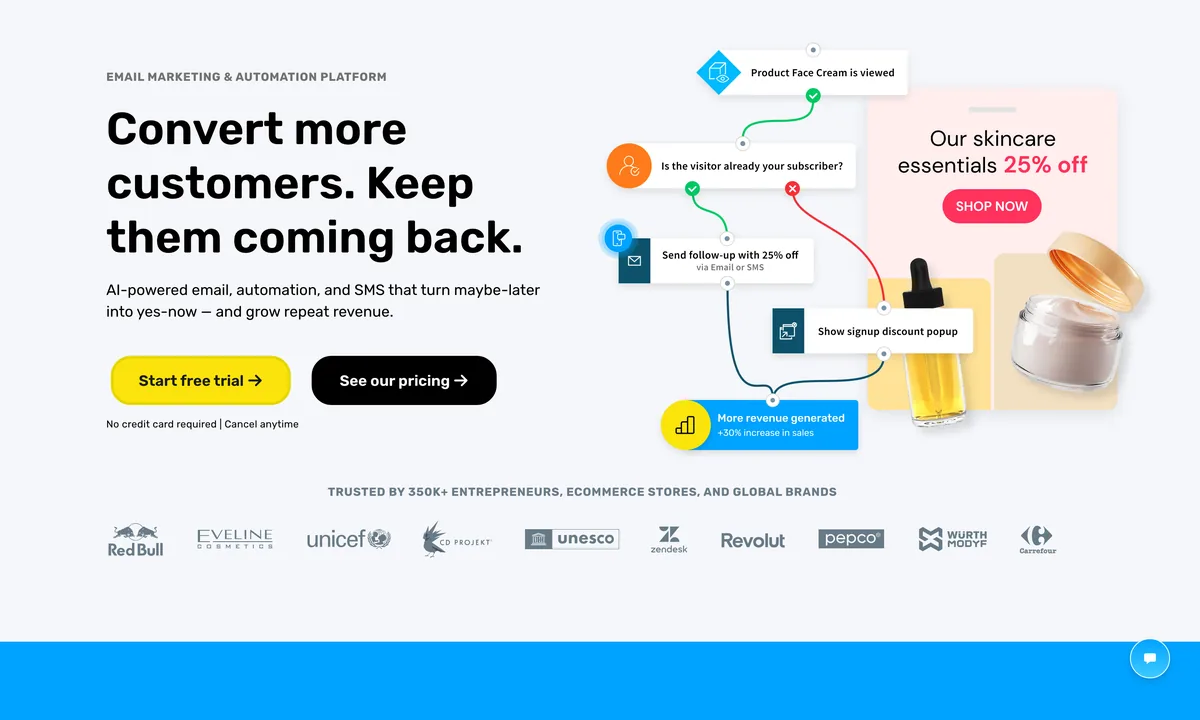
GetResponse includes ecommerce-specific features that you would not expect at $15/month: product recommendations in emails, abandoned cart recovery, promo code blocks, and transactional email support. The ecommerce integrations connect to Shopify, WooCommerce, Magento, and PrestaShop. You also get landing pages and webinar hosting in the same plan, which makes it the best value option if you need more than just email. GetResponse's deliverability is consistently strong in independent benchmarks, which matters when you are sending promotional campaigns to a large list. The AI subject line generator and Perfect Timing send optimization are included at the base plan, giving you tools that cost extra at most competitors. For a small ecommerce store not yet generating $5,000 per month, GetResponse covers most requirements at the lowest available price.
Where it falls short: The $15/month plan has basic automation with no conditional branching. Upgrading to the Marketing Automation plan at $48/month is where the full ecommerce automation capability lives. GetResponse's Shopify integration is functional but not as deep as Klaviyo's or Omnisend's native connector. No SMS channel.

ActiveCampaign
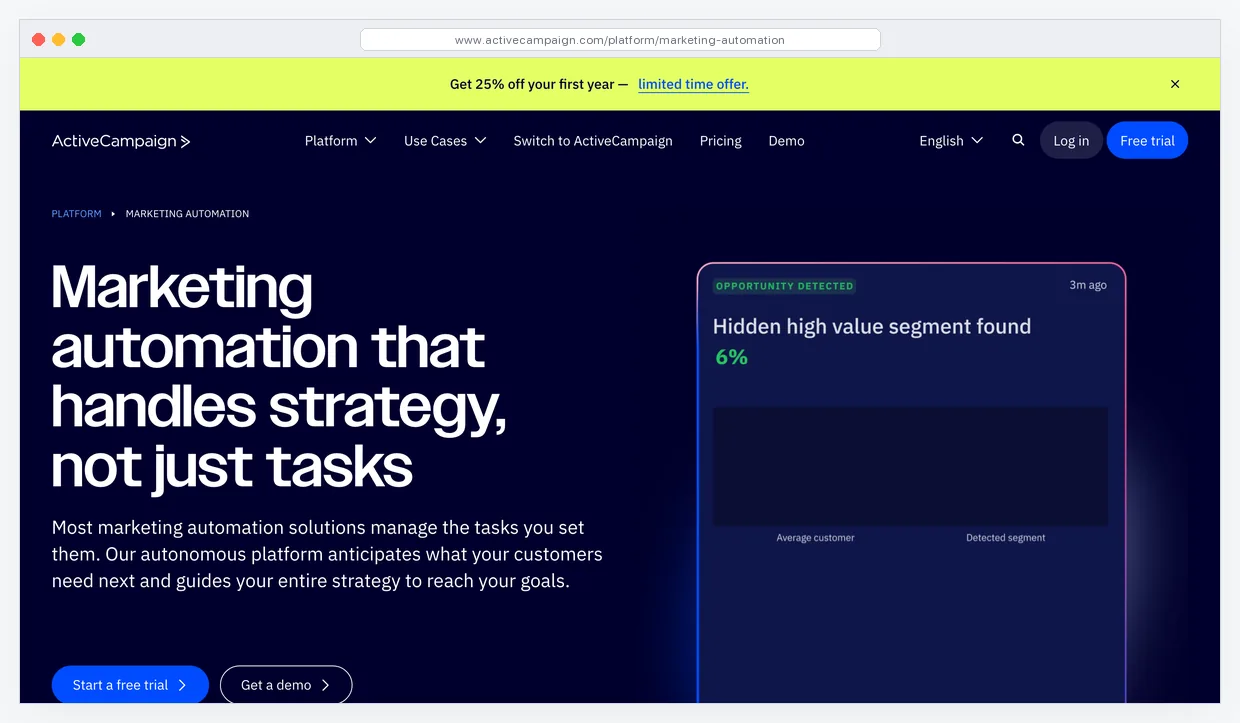
ActiveCampaign's deep data integration for Shopify passes purchase history, product categories, order value, and browsing behavior into the email platform, which then triggers automations based on that data. A customer who buys a specific product category can enter a tailored sequence. A customer whose order value drops can trigger a win-back flow. The automation builder supports conditional branching, lead scoring, and deal creation in the CRM, all from the same sequence. The $29/month Starter plan covers 1,000 contacts with basic automation. The Plus plan at $49/month unlocks the deep data integration, CRM, and the AI features. For stores generating $10,000 per month or more in revenue, the behavioral triggers at the Plus tier tend to produce measurable increases in repeat purchase rate and average order value from automated sequences.
Where it falls short: The platform has a learning curve. Building complex automations takes time and the interface is not as intuitive as Omnisend for standard ecommerce flows. No built-in SMS channel. At the Starter plan, the value is limited compared to Omnisend or GetResponse. The real capability requires the Plus plan at $49/month minimum.
Klaviyo
Klaviyo is Shopify's official email partner and the most widely used email platform among Shopify stores. The free plan covers 500 contacts and 500 email sends per month, which is enough to set up your core flows before paying anything. Paid plans start at $20/month for up to 500 contacts with unlimited sends. Klaviyo's predictive analytics calculate customer lifetime value, churn probability, and expected next purchase date for every contact in your list. The segmentation engine is the strongest of any tool on this list. You can build audiences based on predicted spend, product category preferences, RFM scores, and combinations of behavioral data. For a Shopify store doing significant revenue, Klaviyo's data layer produces segments that no other tool matches at under $50/month.
Mailchimp
Mailchimp connects to Shopify and covers the basics: abandoned cart, welcome series, and post-purchase emails. The free plan handles up to 500 contacts and 1,000 emails per month. The Essentials plan at $13/month unlocks unlimited email sends, A/B testing, and email scheduling. The interface is the most beginner-friendly on this list, which is why it remains the default choice for first-time ecommerce store owners. Segmentation is limited on the Essentials and Standard plans. Advanced audience segmentation requires the Premium plan at $350/month, which puts it out of reach for most small stores. For a store generating under $5,000/month that just needs basic automation running, Mailchimp's simplicity is a genuine advantage.
Drip
Drip positions itself as an ecommerce CRM rather than a general email marketing tool. It has native integrations with Shopify and WooCommerce and a visual automation builder designed around purchase events and customer lifecycle stages. The $39/month plan covers up to 2,500 contacts with unlimited email sends. Every plan includes the full feature set with no gating by tier. Drip's revenue attribution reporting shows exactly which automations and campaigns are generating purchases. For stores that want to know the dollar value of each email workflow, Drip's reporting is cleaner than most alternatives. The visual workflow builder is one of the easiest to use for building complex multi-branch sequences.

Moosend
Moosend includes abandoned cart automation, product recommendation emails, and weather-based trigger campaigns in its base plan at $9/month for up to 500 subscribers. The automation builder handles conditional sequences and behavioral triggers. For a small ecommerce store that wants real automation capabilities without paying $16/month or more for Omnisend, Moosend is the most capable option at the lowest price. The product recommendation feature uses AI to suggest items based on purchase history and browsing behavior. It is not as sophisticated as Klaviyo's predictive layer, but it works and is included at every price tier.

beehiiv
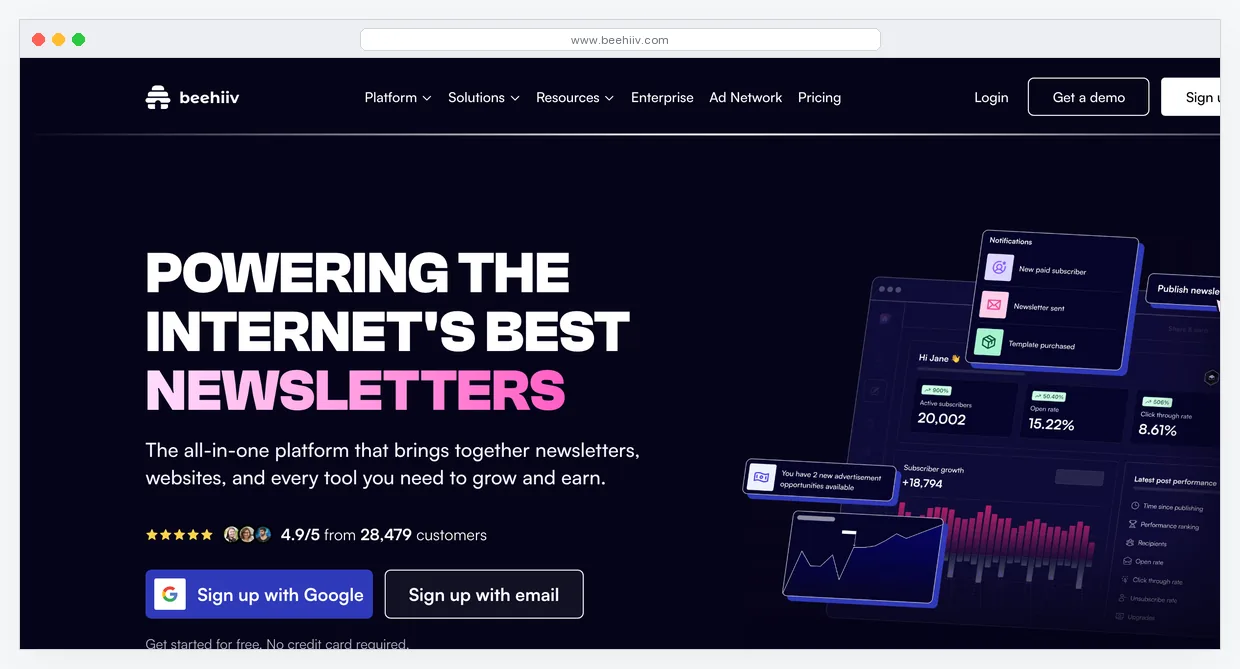
beehiiv is not an ecommerce email platform. It is a newsletter platform that DTC brands use to build an owned audience alongside their store. A typical setup: a Shopify store runs its transactional and promotional emails through Klaviyo or Omnisend, and separately runs a content newsletter through beehiiv that drives brand affinity and repeat purchases over time. The two tools serve different functions. The free plan covers up to 2,500 subscribers with a custom domain and website. Paid plans at $43/month unlock the ad network, boosts, and paid subscription tiers with 0% platform fee. For a DTC brand building an editorial newsletter as a customer retention channel, beehiiv is the best infrastructure for that specific use case.
ConvertKit (Kit)
ConvertKit, now rebranded as Kit, is built for creators and works well for DTC brands that sell digital products alongside physical ones. The free plan covers up to 10,000 subscribers with unlimited landing pages and forms, one automation, and one email sequence. Paid plans start at $9/month with unlimited automations and sequences. ConvertKit's Commerce feature lets you sell digital products directly from ConvertKit without a separate checkout platform. For a store that sells physical products through Shopify and digital downloads (templates, guides, courses) as add-ons, ConvertKit can handle the digital side without an additional tool.
Lemlist
Lemlist earns a place on this list for a specific use case: B2B ecommerce brands prospecting for wholesale buyers, retail stockists, or corporate accounts. It is not a customer email platform. It is an outbound cold email tool with AI personalization that generates custom text variables and personalized images for each prospect. For a brand trying to get into retail accounts, Lemlist handles the outreach at scale. The $39/month plan includes unlimited campaigns, access to the lead database, and AI personalization. Sequences can combine email with LinkedIn and phone steps. Reply rates on well-personalized sequences in wholesale outreach typically run 8 to 15 percent, compared to under 2 percent for generic cold email blasts.
Not Sure Which Email Platform Fits Your Store?
Paste your website URL and get a personalized recommendation in 30 seconds.
Analyze My Stack →Frequently Asked Questions
Klaviyo vs Omnisend for Shopify: which should I choose?
For most Shopify stores under $500,000/year in revenue, Omnisend is the better starting point. The free plan and $16/month Standard plan give you all the core ecommerce flows plus SMS without any extra configuration. Klaviyo's predictive analytics (CLV, churn probability, expected next purchase) become genuinely useful once you have 12 or more months of purchase history and a list large enough for the predictions to be statistically reliable. Switch to Klaviyo when you have 5,000 or more contacts, consistent revenue, and the time to use the advanced segmentation tools.
Is Klaviyo worth the price for a small Shopify store?
At under 500 contacts, Klaviyo's free plan is the same cost as Omnisend's free plan and the feature set is comparable. The price diverges as your list grows: Klaviyo at 5,000 contacts costs around $100/month while Omnisend is $59/month for the same size. The extra cost makes sense if you are actively using the predictive analytics and running more than five distinct audience segments. If you are running three standard flows (abandoned cart, welcome, post-purchase) and a monthly broadcast, Omnisend covers that for less.
What is the best free email tool for ecommerce?
Omnisend's free plan is the strongest for ecommerce. It covers 500 emails/month with the automation builder included, which means you can set up abandoned cart and welcome flows before paying anything. Klaviyo's free plan matches that for Shopify stores. Mailchimp's free plan is easier to set up but its automation is more limited. If you need to launch ecommerce flows with $0 in monthly software cost, start with Omnisend on Shopify or WooCommerce.
How much does email marketing actually generate for an ecommerce store?
Industry benchmarks put email at 20 to 30 percent of total ecommerce revenue for stores with functional automation in place. Abandoned cart flows alone typically recover 5 to 8 percent of abandoned carts. A standard three-email abandoned cart sequence at a $60 average order value and 1,000 abandoned carts per month would recover around 60 to 80 orders, which is $3,600 to $4,800 per month from one automation. The actual number depends on your niche, price point, and traffic quality, but the directional math explains why ecommerce email tools pay for themselves quickly.
When should I switch from Mailchimp to a dedicated ecommerce email tool?
Switch when you hit any of these: (1) your Mailchimp bill exceeds $30/month and you are not using advanced segmentation, (2) you need SMS alongside email, (3) you want purchase-triggered automations beyond the basic abandoned cart, or (4) you want revenue attribution reporting to see which emails are actually generating sales. Any of those points means Omnisend or Klaviyo will do more for a similar or lower price than scaling up on Mailchimp.